

Funnelish
Rating: ⭐️⭐️⭐️⭐️
Last Updated: November 17, 2026
Funnelish is a sales funnel and landing page builder designed to optimize conversions for e-commerce and online businesses. The platform provides customizable templates, upsell flows, and analytics tools to maximize revenue performance. Built for marketers seeking high-converting page structures, Funnelish emphasizes speed, responsiveness, and design efficiency. It supports scalable digital sales strategies through streamlined funnel creation.
|
Category |
||
|
Free Trial |
14 Days |
|
|
Starting price |
$0 |
|
|
Use Case |
||
|
Best for |
This page contains affiliate links. We may earn a commission when you click links to our partners. But rest assured that our reviews are editorially independent and not influenced by commissions. Read Affiliate Disclosure
Jump to section:
Overview
Funnelish Review: Built for Ecommerce Funnels, Not Generic Landing Pages
You’re spending $50 to get a visitor to your product page, and 97 out of 100 of them leave without buying. Nothing is wrong with your ad. The path between the click and the sale is leaking.
A standard store gives shoppers a dozen ways to wander off. A funnel gives them one road, with a few well-timed offers along it. Funnelish is built for that second approach.
I looked at whether it earns its price, and who should skip it.
⚡ Quick Verdict
Funnelish is an ecommerce funnel builder. It covers the landing page, checkout, order bumps, upsells, downsells, thank-you pages, analytics, payment routing, automations, and Shopify order sync in one place.
Best for: dropshippers, one-product brands, DTC offers, paid social campaigns, agencies building client funnels, and Shopify merchants who want more checkout control.
Skip it if you only need a basic store, a content-heavy site, or a simple landing page.
The catch: it asks you to think like a funnel operator. You need to understand offer structure, payment gateways, fulfillment sync, analytics, and post-purchase logic. If that sounds like overkill, Shopify plus a lighter page builder is probably enough.
What Does This Tool Do?
Funnelish is an ecommerce-focused funnel builder for brands that want more control over the customer journey than a standard Shopify product page or generic landing page builder provides.
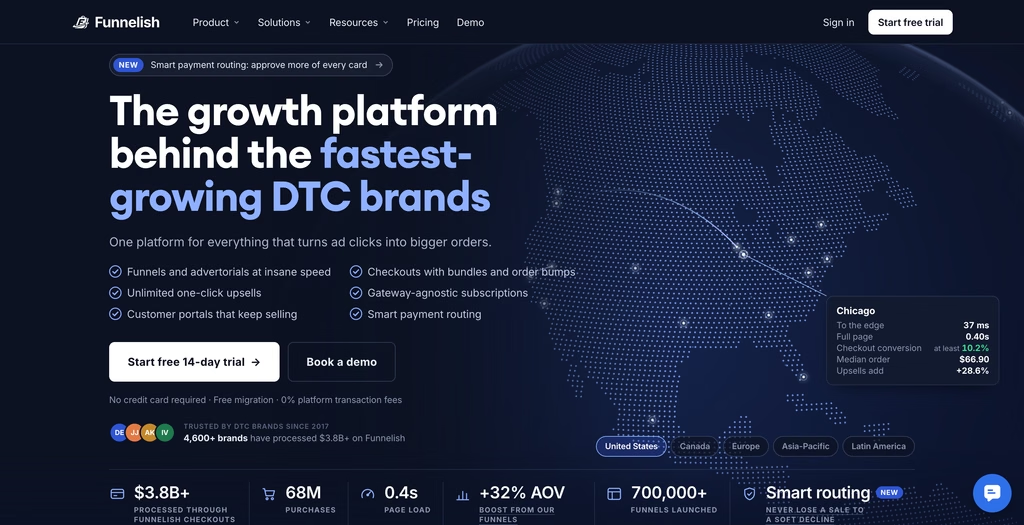
Its core promise is simple: build the full selling path in one place—landing page, checkout, order bumps, upsells, downsells, thank-you pages, analytics, payment routing, automation, and Shopify order sync.
That makes Funnelish more specialized than ClickFunnels and more ecommerce-native than many landing page builders. It’s not trying to be a general website CMS, but is built for merchants who care about conversion rate, average order value, payment flexibility, and paid traffic economics.
Featured Deals and Offers
Offers, pricing, and promo codes can change without notice. Check the official website for the latest terms.
Get Funnelish offer alerts
Be the first to know about new deals, discounts, and trial offers for Funnelish.
Use Cases
Who Should Use This Tool?
Brands running paid traffic. When you’re paying for Meta, TikTok, Google, or influencer traffic, a small lift in checkout conversion or average order value changes your campaign economics. Order bumps, upsells, downsells, and payment routing aren’t cosmetic. They raise revenue per visitor, which gives you more room to acquire customers profitably.
Dropshippers. Funnelish pitches fast page speed, smart payment routing, automated fulfillment, and Shopify sync. But a funnel doesn’t replace the fundamentals: product selection, supplier reliability, creative testing, refund handling, shipping expectations, and support.
Shopify merchants who want checkout flexibility. Funnelish syncs customer data and paid orders back into Shopify, so your fulfillment, shipping, and email workflows keep running. You keep Shopify as the backend and use Funnelish as the conversion layer.
Agencies. Repeatable structures for advertorials, offer pages, upsell sequences, and localized funnels. Shared components are unlimited on every plan, which cuts repetitive work across clients.
Hero-product DTC brands. A single product, a bundle, a trial, a subscription, or a seasonal campaign fits better than a large catalog where browsing and filtering matter more.
Who Should Look Elsewhere?
Shopify stores that just need better pages. A lighter builder like GemPages may be more practical. It includes a sales funnel feature with post-purchase offers, A/B offer testing, templates, analytics, and Shopify Checkout support.
WooCommerce stores. CartFlows is the more native fit, with funnel building plus cart, abandoned-cart recovery, coupons, and product options.
Coaches, creators, and info-product sellers. ClickFunnels is broader, covering funnels, websites, courses, communities, email, workflows, CRM, memberships, and affiliate tools.
Early-stage stores with no traffic. If you don’t have traffic, creatives, or a validated offer, it’s premature. A funnel optimizes a selling path. It can’t make an unproven product profitable.
Key Features and Benefits
Funnel builder
A drag-and-drop builder manages the landing page, checkout, upsell, downsell, and thank-you page inside one workflow. The value is control. A normal store gives shoppers many paths, which dilutes focus when you’re pushing one offer.
Custom checkout, order bumps, and upsells
This is the main reason to consider the platform. An order bump is a small complementary offer added at checkout. A post-purchase upsell lets the customer accept another offer after paying, without re-entering card details. A downsell gives you a second shot if they decline the upsell. If the funnel earns more from the same buyer, you can often afford a higher acquisition cost.
Shopify orders sync
Many merchants don’t want to abandon Shopify. They rely on its apps, inventory, fulfillment, and support processes. Funnelish works best as the conversion layer with Shopify as the operational backend.
Funnelish Pay
This is not a payment gateway. It’s a layer that connects your own gateways, such as Stripe, NMI, and PayPal, to your checkout, handling forms, payment methods, upsells, subscriptions, refunds, and gateway webhooks. Your money still flows through your own accounts, under your own agreements and payout schedules. That matters because payments affect approval rates, chargebacks, payout timing, and risk.
Smart payment routing
Funnelish markets it as a way to recover failed payments. The Advanced plan references gateway pools that route transactions intelligently. Early-stage stores probably don’t need it, but once payment failures start costing you revenue, routing flexibility becomes a real advantage.
Automation and fulfillment
Shopify sync, email autoresponders, Facebook events tracking, 20+ integrations, custom code, SMS automations, SMTP email, and conditional workflows mean fewer manual handoffs between checkout, fulfillment, ad tracking, email, and support.
Analytics and profitability reporting
Step-level visibility tells you where users drop, which upsells convert, and where ad spend stops being profitable. A funnel builder without analytics is just a page builder, so you’ll only get your money’s worth if you use the reporting to make decisions.
Geo-funnels
Serve different markets with different prices, copy, offers, and payment methods while keeping versions organized. This matters for international sellers, since a payment method that works in one country may not be preferred in another.
AI funnel builder (beta)
Funnelish has discussed an interactive AI builder that can start from scratch, a product picture, or a reference link, generate funnel pages, and let you refine sections conversationally before moving into the full editor. Treat it as a way to get a first draft faster, not a replacement for strategy. It can’t tell you whether your offer is strong or your traffic is profitable.
User Experience
Open the Funnelish dashboard and it looks like any other funnel builder. If you’ve used one before, you’ll find your way around in minutes, because nothing about the layout asks you to relearn the basics.
Getting started is quick. Funnelish ships with templates, so if you want a funnel live fast, you can pick one and adapt it instead of building from scratch. For a first test or a simple offer, that’s a real time saver.
The drag-and-drop builder covers most of what you’ll need. You can build and edit your pages without any coding skills, which matters if you’re a solo founder or a marketer without a developer on call.
Customization is where it gets harder. Changing how a page looks is easy. Changing how the funnel itself flows is not. If you want to customize the logic of the funnel, such as how buyers move from one step to the next, you’ll want someone with coding skills to implement it. That’s not a dealbreaker, but plan for it. If your funnel idea is a standard sequence of landing page, checkout, bump, and upsell, templates and the builder will carry you. If you want something unusual, budget for developer time.
That split mirrors a bigger point. The editor isn’t the hard part. Funnel thinking is. A Shopify store asks, “How do we help customers browse and buy?” A funnel asks, “What’s the most profitable sequence for this specific offer?” That takes upfront planning, so before you build, answer these:
- What traffic source is this funnel for?
- What’s the primary offer?
- What objection does the landing page handle?
- What bump belongs at checkout?
- What upsell makes sense right after purchase?
- What happens if the customer declines?
- What data needs to sync to Shopify or fulfillment?
- Which events need to fire for ad tracking?
- Which payment methods are available in each market?
Notice that the more of those answers deviate from a standard funnel, the more likely you are to hit the customization wall above.
Pricing and Value
| Plan | Price | Main fit | Important limits or notes | Action |
|---|---|---|---|---|
| Free | $0 | Testing Pro features before you commit | Get FREE trial | |
| Basic | $49 | Good for testing a funnel concept | Up to 20,000 visitors a month, 20 funnels, 10 eCom blogs, 1 custom domain, 2 team members | Visit website |
| Pro | $99 | Growing brands that need more visitors, funnels, domains, team members, and support | Up to 100,000 visitors a month, 50 funnels, 100 eCom blogs, 5 custom domains, Up to 5 team members | Visit website |
| Advanced | $249 | For high-volume operators who need unlimited funnels and visitors, more stores and domains, and gateway pools | Unlimited visitors, funnels and blogs, 50 custom domains, Up to 15 team members | Visit website |
| Enterprise | Custom | Custom plan priced on your volume | Visit website |
What You’ll Actually Pay
- Basic: $49/month, or $41/month billed yearly. Good for testing a funnel concept.
- Pro: $99/month, or $83/month billed yearly. The practical middle tier for growing brands that need more visitors, funnels, domains, team members, and support.
- Advanced: $249/month, or $208/month billed yearly. For high-volume operators who need unlimited funnels and visitors, more stores and domains, and gateway pools.
- Enterprise: contact sales.
Which Plan Offers the Best Value?
The annual discount: by my math, paying yearly saves about 16% on each plan. Basic drops from $588 to $492 a year, saving $96. Pro drops from $1,188 to $996, saving $192. Advanced drops from $2,988 to $2,496, saving $492.
Other points to know: subscriptions are non-refundable after billing, though cancelled plans stay active until the end of the billing period. The pricing page also lists Stores and Customer Portals as coming soon, so don’t buy for features that aren’t live yet.
Is it good value? It’s easiest to justify when the funnel already generates revenue, or when your paid traffic volume makes a conversion lift financially meaningful. If AOV and checkout conversion don’t yet move your profit, it’s too early.
Pros and Cons
Strengths
- Built for ecommerce funnels, not generic pages
- Strong AOV tools: bumps, upsells, downsells, and bundles
- A Shopify-friendly workflow that preserves your backend
- Broad payment flexibility through your own gateways
- Subscription pricing without a platform commission on sales
- Funnel structure, analytics, and checkout control that matter when acquisition costs bite
- Automation depth that reduces disconnected tools
Trade-offs
- Weak fit for traditional catalog stores, since it’s built for offer-led funnels
- You still need a strong offer and conversion logic
- Simple needs can outgrow the price
- Some features are still marked “coming soon”
- Annual pricing references need verification at checkout
- It doesn’t replace sourcing, support, fulfillment, compliance, or payment-risk management
Frequently Asked Questions
Is Funnelish better than Shopify?
Not exactly. Shopify is the better ecommerce backend. Funnelish is better for focused funnels with custom checkout, upsells, and payment routing. For many merchants, the strongest setup is both.
Does it replace ClickFunnels?
For ecommerce funnels, it can. For courses, coaching, communities, and broader digital products, ClickFunnels may fit better.
Does it charge transaction fees?
It markets 0% additional processing fees. You still pay normal fees to Stripe, PayPal, or whichever processor you use.
Can it sync with Shopify?
Yes. It sends customer data and paid orders to Shopify and triggers existing fulfillment, shipping, and email workflows.
Is it good for dropshipping?
Yes, when you understand paid traffic, offer testing, supplier reliability, shipping expectations, and support. It builds and optimizes the sales path, but it won’t fix a weak product or poor fulfillment.
Does it have AI?
There’s an AI funnel builder in beta that can generate pages from a product image, a reference link, or a blank prompt, then let you refine conversationally.
Is it worth it?
If your business depends on direct-response funnels, paid traffic, upsells, and checkout optimization, yes. If you only need a basic storefront or a simple Shopify page builder, probably not.
Bottom Line
Funnelish is a serious ecommerce funnel platform for merchants who care about conversion economics. It’s strongest when your model depends on turning paid traffic into profitable orders through a controlled path: landing page, checkout, bump, upsell, downsell, fulfillment sync, and analytics.
Buy Funnelish if you run ecommerce campaigns, sell hero products, test paid traffic offers, manage dropshipping funnels, or want Shopify-backed operations with more checkout and upsell control.
Skip it if you’re still validating your product, only need a basic store, or don’t want to manage a funnel system’s moving parts.
The practical test is simple. If raising AOV, improving checkout conversion, and controlling post-purchase offers would materially change your profit, Funnelish deserves a serious look. If those levers don’t matter yet, start simpler.
Overview
⚡️Quick verdict
What is
Funnelish
Featured deals and offers
Offers, pricing, and promo codes can change without notice. Check the official website for the latest terms.
Funnelish
is best for
Who should look elsewhere
Funnelish
key features and benefits
Problems Solved
Funnelish
user experience: what using it feels like
Funnelish
pricing and value
| Plan | Price | Main fit | Important limits or notes | Action |
|---|---|---|---|---|
| Free | $0 | Testing Pro features before you commit | Get FREE trial | |
| Basic | $49 | Good for testing a funnel concept | Up to 20,000 visitors a month, 20 funnels, 10 eCom blogs, 1 custom domain, 2 team members | Visit website |
| Pro | $99 | Growing brands that need more visitors, funnels, domains, team members, and support | Up to 100,000 visitors a month, 50 funnels, 100 eCom blogs, 5 custom domains, Up to 5 team members | Visit website |
| Advanced | $249 | For high-volume operators who need unlimited funnels and visitors, more stores and domains, and gateway pools | Unlimited visitors, funnels and blogs, 50 custom domains, Up to 15 team members | Visit website |
| Enterprise | Custom | Custom plan priced on your volume | Visit website |