
Emergent.sh
Rating: ⭐️⭐️⭐️⭐️
Last Updated: October 28, 2026
Emergent.sh is an AI-powered developer platform that simplifies code migration, modernization, and maintenance for software teams.
Designed for engineering teams, Emergent supports planning, coding, testing, and deployment processes through intelligent automation. The platform enhances efficiency by reducing manual code refactoring and integration efforts. Built for scalable development environments, Emergent helps teams accelerate modernization initiatives and maintain robust applications.
|
Category |
||
|
Free Trial |
Forever |
|
|
Starting price |
$0 |
|
|
Use Case |
||
|
Best for |
This page contains affiliate links. We may earn a commission when you click links to our partners. But rest assured that our reviews are editorially independent and not influenced by commissions. Read Affiliate Disclosure
Jump to section:
Overview
Emergent.sh Review: Skip the Dev Backlog, But Watch Your Credits
Every founder has the same story. You have an app idea. You’re sure it’s good. Then you get the quote from a developer, or the engineering team tells you the backlog is full until Q3.
So the idea sits in a notes app and dies there.
Tools like Emergent.sh exist to break that pattern. The question is whether they deliver, or whether they just burn through your credits.
A quick note on how I review tools: practical buying guidance, no star ratings, no inflated claims, and no conclusions based on review scores alone.
⚡ Quick Verdict
Emergent.sh is an AI app builder. You describe the software you want in plain English, and AI agents design, code, test, and deploy it. It covers web apps, mobile apps, dashboards, SaaS tools, internal tools, and customer-facing apps.
Who it’s for: founders, agencies, operators, product managers, and small business owners who need a working prototype or early product without waiting weeks or paying a developer up front.
What it won’t do: replace experienced engineers. Its real value is compressing the early build phase: planning screens, generating frontend and backend logic, wiring up common integrations, previewing, and deploying.
Where to be careful: mission-critical systems, regulated workflows, complex multi-tenant SaaS, and unusual backend architectures all need developer review before launch. TechRadar’s independent testing found Emergent useful but slower than several competitors, and its credit model can pinch while you’re still experimenting.
My recommendation: use it for MVPs, internal tools, client prototypes, simple SaaS, operational dashboards, and early mobile concepts. Hold back if you need predictable costs, deep engineering control, or production reliability with no technical oversight.
What Does This Tool Do?
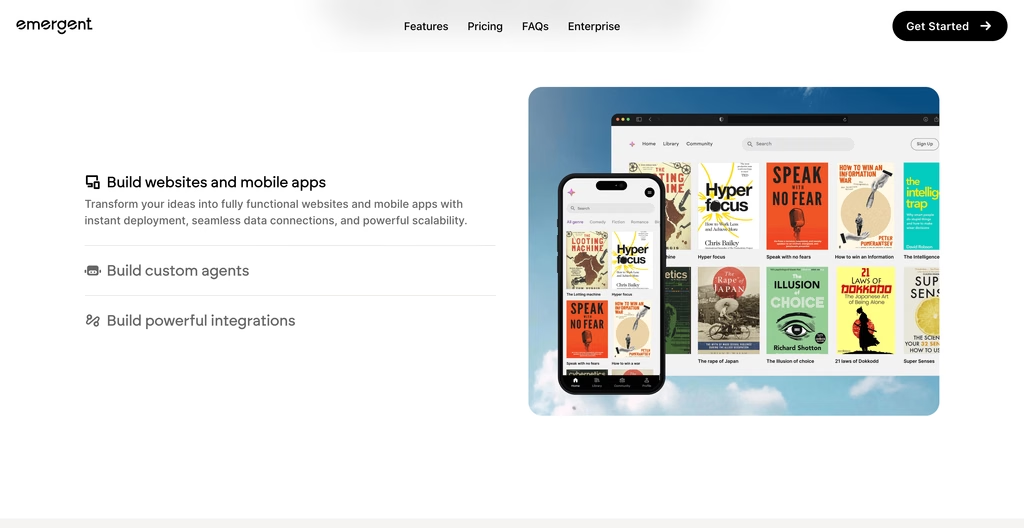
Traditional no-code builders ask you to drag components around, configure database tables, and assemble workflows by hand. Emergent asks you to describe what you want. Its documentation says the platform can build full-stack web and mobile apps, including frontend, backend, database, authentication, APIs, and deployment.
That changes the learning curve. The question stops being “how do I use this builder?” and becomes “can I clearly describe the software I need?”
It also matters that Emergent says you own the code. You can connect GitHub, download it, modify it, or host it elsewhere. Many no-code tools lock you into a proprietary runtime. Emergent is trying to avoid that by generating code that can move into a normal development workflow.
Featured Deals and Offers
15% off Emergent.sh annual plans
Sign up for an annual plan to save 15% on Emergent.sh
Claim DealOffers, pricing, and promo codes can change without notice. Check the official website for the latest terms.
Offers, pricing, and promo codes can change without notice. Check the official website for the latest terms.
Get Emergent.sh offer alerts
Be the first to know about new deals, discounts, and trial offers for Emergent.sh.
Use Cases
Who Should Use This Tool?
Solo founders building an MVP. If you have an idea but not enough validation to justify an engineering team, this is the sweet spot. A booking tool, a CRM-lite product, an AI assistant, a customer portal, or a simple SaaS workflow can go from idea to clickable product fast. The real return is avoiding the most expensive mistake in startups: spending months building the wrong thing.
Marketing agencies and consultants. Emergent integrates with HubSpot, Mailchimp, Klaviyo, Shopify, Slack, Google Sheets, Salesforce, Pipedrive, Zoho CRM, and plenty more. That makes it a fit for client portals, campaign dashboards, lead intake systems, lightweight CRMs, and reporting tools. The bigger opportunity is that you can package custom operational tools into higher-value client engagements.
Product managers and ops teams. Finance, marketing, and ops often need a tool that engineering will never prioritize. Emergent’s enterprise positioning targets exactly this, letting teams build secure internal tools without waiting on sprint capacity.
Developers who want a head start. You probably don’t need it for simple coding help. But for scaffolding full-stack projects, spinning up quick internal tools, or turning rough requirements into a working base, it saves real time. GitHub integration lets you move the output into a controlled workflow.
Who Should Look Elsewhere?
Anyone who needs predictable costs. Credits are consumed by generation, code changes, testing, debugging, integrations, troubleshooting, and deployments. When they hit zero, development pauses until renewal or a top-up. Disciplined users can manage that. Beginners who keep asking the agent to “fix it” tend to drain credits fast. Your real cost isn’t the subscription. It’s the number of iterations it takes to get the app working.
Teams building mission-critical software. AI-generated code isn’t automatically production-safe. If your app touches payments, customer data, healthcare, financial decisions, legal workflows, or sensitive records, have a qualified developer or security professional review it first. Emergent advertises SOC 2 Type I, ISO 27001, SSO/SAML, RBAC, and audit logging. Those claims matter to enterprise buyers evaluating governance. They don’t guarantee that every app you generate is secure by default.
People who want visual, granular control. Conversational building is faster for some and less predictable for others. If you want precise control over data types, workflows, reusable components, and database logic, Bubble or a traditional low-code platform may feel more dependable.
Teams with specific architecture needs. Emergent supports React, FastAPI, MongoDB, Next.js, and Expo React Native. Flutter, Kotlin, and Swift aren’t supported for now. That covers a lot of products, but not all of them.
Key Features and Benefits
Conversational app generation
You describe the app, and the platform builds it. Emergent says that covers web apps, mobile apps, dashboards, ecommerce sites, SaaS tools, and internal business apps. The payoff is faster validation. Instead of weeks of wireframes, specs, and tickets, you get something testable early.
Full-stack web and mobile
This isn’t just a landing page generator. Many AI website builders fall apart when you need real application logic. Emergent is built for apps with users, data, logic, and integrations. Mobile support runs through Expo React Native, with FastAPI and MongoDB in the stack.
Deployment and hosting. Preview links expire after 30 minutes. Deployment creates a live app meant to stay up, at 50 credits per deployed app. The package includes managed production infrastructure, uptime monitoring, SSL, custom domains, environment variables, and secrets. That’s less DevOps work for you, but it’s a cost to factor in.
GitHub integration. You can push and pull code, manage branches, collaborate, and recover earlier versions. The docs recommend saving after major features, before refactors, and at the end of each session. This may be the most buyer-friendly feature on the list, because it gives you a safety net and an easy way to bring in a developer later.
Integrations. The catalog spans AI, databases, design, communication, marketing, sales, ecommerce, project management, support, fintech, and ERP. Examples include Stripe, PayPal, Razorpay, Airtable, Twilio, Figma, Notion, Asana, Monday.com, SendGrid, OpenAI, Claude, Gemini, Supabase, Discord, GitHub, Gmail, HubSpot, Jira, Slack, Shopify, WooCommerce, WordPress, Salesforce, Klaviyo, Mailchimp, QuickBooks, and Zendesk. This is where Emergent goes from prototype generator to a way of building tools around the stack you already run.
Agents and build controls. The FAQ describes E1 for complete production apps, E1.1 for backend-heavy projects, E1.5 for more complex structured builds, and a Mobile Agent for iOS and Android. Pro adds a 1M context window, Ultra thinking, system prompt editing, custom AI agents, high-performance computing, 750 monthly credits, and priority support. Casual builders can probably skip Pro at first. Teams building complex apps will hit the lower plans’ limits quickly.
User Experience
Setup and Ease of Use
Most AI app builders fail at the first step. Nobody has trouble signing up. The trouble starts when you stare at a blank prompt box and realize you don’t know how to describe your app.
Emergent’s setup is easy. Learning to use it well takes longer.
Getting Started: Minutes, Not Hours
There’s no environment to configure, no repo to create, and no database to provision. You sign up, describe the app you want, and the platform takes it from there. Emergent asks clarifying questions before it generates anything, which helps keep the build close to what you intended. Onboarding as about as frictionless as this category gets, and there’s a task manager for planning and tracking the build.
The basic loop looks like this:
- Describe the app in plain English.
- Answer the agent’s clarifying questions.
- Review the preview. Preview links expire after 30 minutes, so don’t treat them as a live app.
- Iterate with follow-up prompts.
- Save to GitHub after major features and before big changes.
- Deploy once you’re happy. This costs 50 credits per deployed app and requires a paid plan.
If your main question is “can I get something on screen quickly?”, the answer is yes.
Testing Results and Limitations
Emergent is built around conversation, not configuration. That’s fast, but it changes what skill you need. The best results come from people who write precise requirements, define data models, describe workflows clearly, and test carefully. Remember that this is a credit-based app so it would be better to do your homework before you even start building: use a separate chatbot to flesh out your idea and write the prompts. Also, don’t be afraid of loading multiple instructions at once, because credits go quickly and vague prompts waste them.
Given all of this, Emergent does produce an attractive, usable web app, which matches how AI app builders generally behave. The first version looks impressive. The real work starts afterward: fixing edge cases, adding permissions, refining data behavior, testing responsiveness, hardening security, and connecting production services.
So the learning curve isn’t the interface. It’s managing an AI-assisted build without losing control of scope, credits, and quality.
Pricing and Value
| Plan | Price | Main fit | Important limits or notes | Action |
|---|---|---|---|---|
| Free | $0 | Testing Pro features before you commit | 10 free monthly credits | Get FREE trial |
| Standard | $20 | Freelancers, solopreneurs, individual users | 100 credits | Sign up for Standard plan |
| Pro | $200 | Brands, small businesses, startups | 750 monthly credits | Sign up for Pro plan |
| Enterprise | Custom | Large Organizations | Custom | Get Enterprise plan |
Which Plan Offers the Best Value?
Emergent.sh has four tiers: Free, Standard, Pro, and a custom Business/Enterprise plan.
Free costs $0 per month and includes 10 monthly credits, which is enough to test the platform but not to complete a real build. One third-party review lists a different structure (5 monthly credits plus 10 daily credits), so check the live pricing page for the current allowance.
Standard costs $20 per month, or $17 per month if billed annually. It includes 100 credits per month and suits first-time builders and small projects.
Pro costs $200 per month, or $167 per month if billed annually. It includes 750 credits per month and adds a 1M context window, Ultra thinking, system prompt editing, custom AI agents, high-performance computing, and priority support. It’s aimed at serious creators and more complex builds.
Business/Enterprise is custom-priced and covers SSO, RBAC, co-editing, audit logs, VPC deployment, self-hosted database support, SLAs, and usage controls.
Annual discount: Paying annually saves roughly 15% on both paid plans. Standard drops from $240 to about $204 per year, a saving of about $36. Pro drops from $2,400 to about $2,004 per year, a saving of about $396. These totals are my calculations from the listed monthly rates.
Credit top-ups are available when you run out: 100 credits for $20, 250 for $50, 500 for $100, 3,000 for $500, and 6,000 for $1,000. That works out to about $0.20 per credit for the smaller bundles and about $0.17 for the two largest.
Points to keep in mind:
- Pro’s per-credit cost is higher than the top-up rate, so you’re paying for the advanced features and priority support rather than cheaper credits.
- Deploying an app costs 50 credits, which is half of Standard’s monthly allowance.
- Development pauses at zero credits until renewal or a top-up, though you keep access to your projects and code.
Pros and Cons
Strengths
- Strong fit for MVPs, prototypes, internal tools, dashboards, and simple SaaS
- Easier for non-technical users than traditional no-code builders
- Builds full-stack apps, not just static sites
- Mobile support extends it beyond web-only prototypes
- GitHub integration gives you backup, version control, and a developer handoff path
- Broad integrations suit marketing, sales, ecommerce, and ops workflows
- Deployment support lowers infrastructure complexity
- Enterprise options include SSO, RBAC, audit logs, VPC deployment, and usage reporting
- Strong funding may ease vendor-viability worries. Emergent reportedly raised a $130 million Series C at a $1.5 billion valuation in July 2026.
Trade-offs
- Credits can get expensive with vague prompts or repeated debugging
- Pricing documentation is inconsistent in places, so verify limits in-app
- AI-generated apps still need human QA, especially for security, permissions, payments, and data handling
- Independent testing found it slower than some competitors
- Conversational building can feel less precise than mature visual no-code platforms
- Advanced governance and team controls appear tied to custom business or enterprise plans
- The supported stack may not fit teams that need Swift, Kotlin, Flutter, or custom backend architecture
- Preview links expire, and persistent deployment costs credits and requires a paid plan
- It can generate software, but it can’t tell you whether the product solves a real market problem
Frequently Asked Questions
Is Emergent.sh really no-code?
For many use cases, yes. You describe the app and it generates the frontend, backend, database, and deployment workflow. But no-code doesn’t mean no review. For production apps, especially those handling payments or sensitive data, get a developer to look at it.
Can it build mobile apps?
Yes. The Mobile Agent builds with Expo React Native, alongside FastAPI and MongoDB. Flutter, Kotlin, and Swift aren’t currently supported.
Do I own the code?
Emergent says you do, and you can use GitHub for version control, download it, modify it, or host it elsewhere. That’s a real advantage over platforms that keep you inside a proprietary builder.
Is it good for agencies?
Yes, especially for client portals, campaign dashboards, lead intake tools, reporting apps, and lightweight automation. The integrations cover many of the marketing, sales, ecommerce, and CRM tools agencies already use.
Is it better than Lovable or Replit?
It depends on the buyer. Emergent suits non-technical users who want a guided conversational builder with full-stack and mobile ambitions. Lovable may feel faster or more polished for some web projects. Replit is usually better for people who want a developer-centric environment. In one prompt-to-app test, independent testing found Emergent useful but slower than several competitors.
Is there a free plan?
Yes, with 10 monthly credits on the current pricing page. Since the documentation is inconsistent, check your actual allowance in your account before planning a serious build around it.
What happens when credits run out?
You can still access your projects and code, edit files manually in VS Code, view deployments, and read the docs. You can’t generate new code, run tests, deploy new builds, or use AI debugging until credits renew or you buy a top-up.
Bottom Line
Emergent.sh is one of the more interesting AI app builders for non-technical founders, agencies, operators, and product teams because it builds complete applications, not just websites. Its best use is taking a business idea, internal workflow, or MVP concept and turning it into something functional enough to test, demo, and iterate on.
It works best when you show up with a clear scope. Define your users, screens, database objects, workflows, integrations, and launch criteria first. Then you’re spending credits on building, not guessing.
It works poorly if you expect production-grade software from a vague prompt. AI-generated apps still need testing, security review, cost control, and product judgment. For serious commercial products, treat Emergent as a fast building partner, not a replacement for engineering discipline.
Choose Emergent if you want to ship an MVP, internal tool, client app, dashboard, or early SaaS product quickly, and you’re willing to validate what it produces.
Choose something else if you need highly predictable costs, deep visual control, native-code mobile development, complex custom architecture, or mission-critical reliability without technical oversight.
Overview
Emergent.sh Review: Skip the Dev Backlog, But Watch Your Credits
⚡️Quick verdict
What is
Emergent.sh
Featured deals and offers
15% off Emergent.sh annual plans
Sign up for an annual plan to save 15% on Emergent.sh
Claim DealOffers, pricing, and promo codes can change without notice. Check the official website for the latest terms.
Offers, pricing, and promo codes can change without notice. Check the official website for the latest terms.
Emergent.sh
is best for
Who should look elsewhere
Emergent.sh
key features and benefits
Problems Solved
Emergent.sh
user experience: what using it feels like
Emergent.sh
pricing and value
| Plan | Price | Main fit | Important limits or notes | Action |
|---|---|---|---|---|
| Free | $0 | Testing Pro features before you commit | 10 free monthly credits | Get FREE trial |
| Standard | $20 | Freelancers, solopreneurs, individual users | 100 credits | Sign up for Standard plan |
| Pro | $200 | Brands, small businesses, startups | 750 monthly credits | Sign up for Pro plan |
| Enterprise | Custom | Large Organizations | Custom | Get Enterprise plan |